

10 Best RingCentral Alternatives for Small Business (2026 Roundup)
What if the phone system you pay for each month is actually the reason you're losing revenue? Many entrepreneurs find themselves trapped in complex contracts with high per-user fees that scale poorly as the team grows. It's common to feel like you're paying for a massive corporate infrastructure when you just need a reliable way to talk to customers. Finding the right RingCentral alternatives for small business isn't just about cutting costs. It's about finding a system that works as hard as you do.
You know the sting of a missed call. When your team is busy, that ring often ends in a voicemail, and a voicemail often means a lost lead. You deserve a solution that goes beyond a simple dial tone to capture leads and automate routine workflows. This 2026 roundup reveals the top ten tools designed to streamline your operations. We'll explore everything from budget-friendly dialers to advanced platforms that manage your communication, ensuring your business stays responsive even when you're offline.
Table of Contents
Why Small Businesses Are Moving Away from RingCentral in 2026
Small business owners are facing a reality check. Enterprise-grade tools often create enterprise-sized headaches. RingCentral offers a robust platform; however, it's increasingly viewed as "overbuilt" for local service providers like HVAC teams or boutique salons. This shift is driving the search for RingCentral alternatives for small business that prioritize outcome-based efficiency over endless feature lists. You need a system that works for you, not one that requires a manual to operate.
The Hidden Costs of Enterprise VoIP
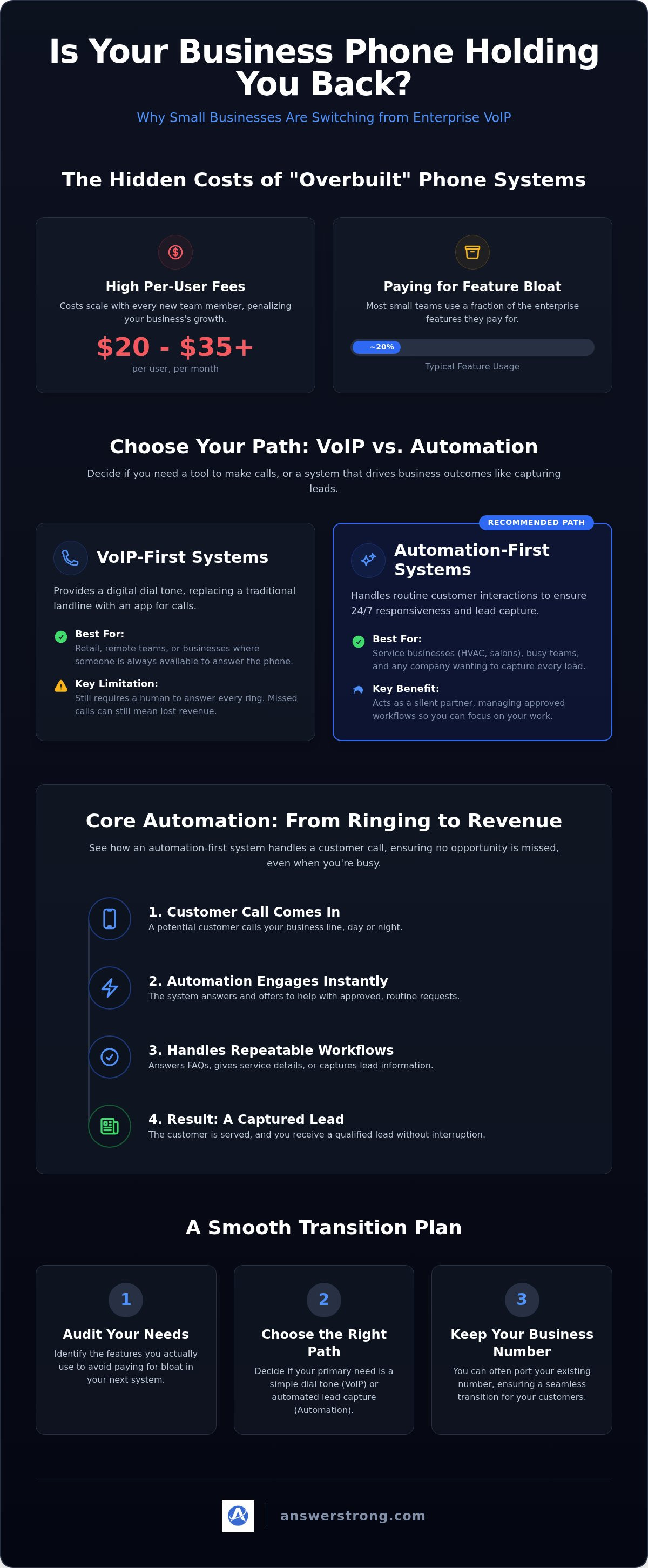
Traditional pricing models often penalize your growth. When you add a new technician or a part-time receptionist, your monthly bill jumps. Research indicates that RingCentral's starting prices often sit in the $20 to $35 per user range. These per-user fees add up quickly. Most small teams use less than 20% of the available enterprise-tier features. Global video conferencing and complex multi-level auto-attendants look great on a brochure. They don't help you clear a drain or schedule a haircut. The real cost isn't just the monthly invoice; it's the missed revenue. When calls hit a busy signal or roll to voicemail, you lose money. A standard business telephone system provides the dial tone, but it doesn't ensure the lead is captured during a rush.
Complexity vs. Productivity
Time is your most valuable asset. Spending hours inside a complex administrative dashboard is a drain on your focus. Many enterprise systems are designed for large corporations with dedicated IT departments. For a local business, this complexity creates a steep learning curve for every new hire. In 2026, the trend is moving toward streamlined, automation-first communication. Small businesses are ditching the bloat for systems that manage the workload. This is where Core Automation changes the narrative. Instead of just letting the phone ring, modern systems handle the actual customer interaction. They manage approved, repeatable workflows like answering FAQs or providing service area details. You stay responsive without being tethered to your desk. The goal is a system that acts as a silent partner, driving your business forward while you focus on the work. You shouldn't have to choose between answering a call and finishing a job.
VoIP vs. Automated Answering: Choosing the Right Category of Alternative
Most entrepreneurs searching for RingCentral alternatives for small business assume they just need a different app to make calls. This is a common trap. Before you sign another contract, you must decide if you need a communication tool or a communication outcome. The market in 2026 is split into two distinct paths: traditional software and intelligent automation.
When a Basic VoIP App is Enough
Traditional Voice over Internet Protocol (VoIP) systems focus on transmission. They provide a digital dial tone on your smartphone, tablet, or laptop. This category is a common starting point when comparing RingCentral alternatives for small business, especially for retail environments where a staff member is always available to answer the phone. If your primary goal is simply to have a professional line for outgoing calls, a reliable mobile app is your main priority. Remote teams often thrive with these systems because they keep everyone connected under one business identity. However, remember that these tools still require a human to be on the other end of every ring. If you are debating between hiring help or using software, our Automated Answering Service vs. Virtual Receptionist: 2026 Buying Guide provides a deeper dive into the operational differences.
When Your Business Needs Core Automation
Service-based businesses, such as HVAC contractors or salon owners, often face a different challenge. You don't just need a phone; you need a way to manage appointments without stopping your work. This is where Core Automation becomes essential. It handles "approved, routine, and repeatable" tasks like capturing lead information or answering basic pricing questions. Modern customer expectations have shifted. People expect 24/7 responsiveness. If a call goes to voicemail, they simply move to the next name on the search results list. Automation ensures your business stays active even when you are on a job site or at home. It acts as a silent, digital receptionist that never gets tired. For many, the best approach is a hybrid model. You can keep your professional business phone numbers while adding layers of intelligent routing. This setup ensures that every prospect gets an immediate response. It turns your communication system into a revenue generator rather than just a monthly expense. Explore how professional communication services can stabilize your growth.
The Best VoIP-First RingCentral Alternatives for Basic Communication
If your team handles every call manually and you just need a reliable digital dial tone, several RingCentral alternatives for small business offer excellent value. These providers focus on the "VoIP-first" experience. They prioritize app stability and call quality over complex automation workflows. Choosing the right one depends on your team size and your current tech stack.
Nextiva: Best for Support and Parity
Nextiva stands as a powerhouse for businesses that want a feature set similar to RingCentral but with better customer support. Their Core plan starts at $15 per user monthly when billed annually. It's a stable platform with a reputation for high-touch service. If you need a direct replacement that won't confuse your staff, Nextiva is a top contender.
Zoom Phone: Best for Integrated Teams
Many small businesses already live in Zoom for meetings. Adding Zoom Phone is a logical, budget-friendly step. The "US & Canada Metered" plan starts at $10.50 per user annually. It's simple to deploy and keeps your communication under one roof. It's an efficient choice for teams that prioritize video collaboration and want to avoid enterprise bloat.
Ooma Office: Best for Hybrid Workspaces
Ooma Office bridges the gap between traditional hardware and modern apps. At $19.95 per user for the Essentials plan, it's designed for small offices that still value physical desk phones. It's easy to set up and offers the professional features you expect without the enterprise complexity. It's a solid choice for local service providers with a fixed front desk.
Grasshopper: Best for Solopreneurs
Grasshopper remains the king of simplicity for one-person shows. Their True Solo plan starts at $14 per month. It provides a professional second line on your personal device. You don't get a full PBX system, but you get the professional image your brand needs. It's ideal for those who aren't ready for a full team system yet.
Comparing Features for 2026
Standard features like call forwarding, SMS, and voicemail-to-email are now baseline requirements. The real test is mobile app performance. According to reviews of the top voice over IP (VoIP) services, stability is everything. You can't afford an app that crashes when a client calls. Look for providers that offer high availability for toll-free numbers and local area codes to maintain your professional presence across the country.
Pricing and Scalability
Scaling should be predictable. Most providers use per-user models that range from $10 to $25 for basic tiers. Grasshopper stands out with its Solo Plus plan at $25 for unlimited users, which is ideal for small teams on a tight budget. Avoid long-term contracts. The communication landscape evolves quickly. You need the freedom to pivot to more responsive systems like Answer Strong when your call volume outpaces your staff's ability to answer every ring.
Solving the Missed Call Problem: Automation-First Alternatives
A ringing phone is a liability if nobody answers it. Most RingCentral alternatives for small business focus on the connection. Answer Strong focuses on the conclusion. Our approach prioritizes outcomes like booked appointments and captured leads over a simple dial tone. Through Core Automation, the system manages your most frequent interactions. It handles FAQs, pricing details, and service area information instantly. If a query is too complex, intelligent routing ensures it reaches a human team member. This transforms your phone system into a digital employee that never sleeps.
Industry-Specific Benefits of Automation
Different industries face unique hurdles. For HVAC and plumbing companies, technicians are often in crawl spaces or on rooftops. They can't stop to book the next job. Using Automated HVAC Booking allows you to capture leads while your hands are full. Salons and barbershops benefit similarly. You can handle appointment requests without interrupting a service or leaving a client mid-cut. Professional service firms maintain a high-tier image with 24/7 responsiveness. Clients get answers immediately. You get a synced calendar. This reduces administrative drag and keeps your schedule full without constant monitoring.
Beyond the Dial Tone: Managing Workflows
Managing a business requires clear visibility. A centralized dashboard allows you to track every activity, usage metric, and customer note in one place. This isn't just about the call itself. It's about what happens next. Automated follow-ups via SMS and email ensure that prospects feel valued long after the initial contact. This continuity builds trust and turns a one-time caller into a repeat customer. For growing businesses, the Answer Strong Essential Plan provides the framework to stay responsive without increasing your payroll. It's time to stop paying for a dial tone and start investing in your outcomes. Explore how professional communication services can stabilize your growth and capture every opportunity.
Switching from RingCentral to a More Responsive System
The transition to a more agile communication platform doesn't have to be a technical nightmare. If you've decided to explore RingCentral alternatives for small business, the key is a methodical approach. You're moving away from enterprise bloat toward a system that prioritizes answered calls and booked appointments. This change allows you to reclaim your focus while the technology handles the routine interactions.
Step 1: Audit your usage. Look at your last three monthly bills. Identify features you pay for but never touch. Most small teams find they only use a fraction of enterprise-tier tools.
Step 2: Define your number strategy. Decide if you'll keep your existing business identity or start fresh with new business phone numbers.
Step 3: Configure your workflows. Set up your routing rules and your Core Automation logic to handle frequent customer inquiries.
Step 4: Conduct a live test. Call your new system from a personal device. Ensure the routing logic and automated responses feel natural and helpful.
Step 5: Onboard your team. Show your staff how to use the centralized dashboard at portal.answerstrong.com. A quick walk-through of the mobile tools ensures everyone is ready for the switch.
Porting Your Number Successfully
Identity continuity is vital for local service providers. You've spent years building trust around your current phone number. When moving to RingCentral alternatives for small business, you can often port your existing number to maintain that connection. To ensure a smooth transfer, ask your current provider for a Customer Service Record (CSR). This document contains the exact billing address and account details required for a successful port. During the transition, you can use call forwarding as a temporary bridge. This ensures you don't lose a single lead while the digital paperwork clears.
Setting Up Your First Automation Workflow
Your communication system should reflect your actual business hours. Start by defining your primary routing logic. During the day, calls might go to your team; after hours, they should trigger a responsive automation. Input your frequently asked questions, such as service area details or basic pricing, into the engine. This allows the system to provide immediate value to callers without your intervention. You can learn more about Core Automation setup to see how these repeatable workflows stabilize your growth. By syncing these interactions with your calendar, you reduce administrative drag and keep your focus on the job at hand.
Future-Proof Your Business Communication Today
The shift away from enterprise complexity toward outcome-driven results is a defining trend for 2026. You don't need more features; you need more answered leads. Choosing the right RingCentral alternatives for small business means finding a system that scales without penalizing your growth. Whether you require a simple digital dial tone or a robust automation engine, your communication should empower your team rather than drain your resources.
Answer Strong bridges this gap by focusing on what actually moves the needle. With 24/7 call handling and automation, your business stays responsive at all times. You can maintain your professional business phone numbers while managing every interaction through a centralized activity dashboard. This setup removes the stress of missed opportunities and lets you focus on high-value work. It's time to build a system that works for you. Find the Right AnswerStrong Setup for Your Business and start capturing every lead with confidence.
Frequently Asked Questions
Can I keep my existing business number when switching from RingCentral?
Yes, you can keep your existing business identity through call forwarding or supported number-porting processes. Maintaining continuity is vital for established service providers who've built their brand around a specific number. When evaluating RingCentral alternatives for small business, ensuring your current provider can release your number for transfer or allow seamless forwarding is a critical first step in the transition process.
Does Answer Strong replace my need for a receptionist?
Not necessarily; the platform is designed to be flexible. It can function as your primary communication hub or work alongside an existing receptionist to handle overflow during busy periods. It provides essential coverage for sick days, vacations, and after-hours inquiries. This ensures your business stays responsive without the overhead of hiring additional full-time staff, acting as a tireless digital assistant for your team.
How does Core Automation handle appointment scheduling?
Core Automation manages appointment requests based on the specific scheduling rules and integrations you configure for your business. It collects necessary customer details and checks your availability to suggest or book time slots. This eliminates the back-and-forth emails and phone tag typically associated with scheduling. By syncing directly with your calendar, the system keeps your agenda organized and ensures you stay focused on serving your clients.
Do I need to buy new physical phones to use a RingCentral alternative?
No, you don't need to purchase new physical hardware to modernize your communication. Calls can be routed to your existing mobile phones, office lines, or specific departments within your organization. This flexibility allows your team to stay connected regardless of their location. It's a cost-effective way to upgrade your system without the burden of expensive VoIP hardware or complex on-site installations.
What is the difference between a VoIP service and an automated answering service?
A standard VoIP service provides the digital dial tone and software needed to make and receive calls via the internet. An automated answering service, like Core Automation, goes further by handling the actual conversation and routine workflows. While VoIP connects the call, automation manages tasks like answering FAQs and booking appointments. This distinction is vital when comparing RingCentral alternatives for small business to find a solution that drives outcomes.
Can Answer Strong handle calls for my business after hours?
Yes, the platform is built to provide 24/7 responsiveness. You can configure specific business-hours routing logic and after-hours handling to ensure your company never stops communicating. Core Automation takes over when you're offline, answering routine questions and collecting lead information while you rest. This proactive approach ensures that late-night inquiries are handled professionally, giving you a significant advantage over competitors who rely on simple voicemail.
Is it difficult to set up automated call routing for a small team?
Setting up automated routing is a straightforward process designed for business owners, not IT experts. You can define simple rules for how calls should flow between team members or departments based on the time of day. The system is built for gradual implementation, allowing you to start with basic forwarding and add complex automation layers as your needs grow. This methodical setup ensures your communication remains organized and efficient from day one.
How do I manage my business communication settings and call logs?
You manage all settings, activity logs, and automation configurations through a centralized dashboard at portal.answerstrong.com. This portal provides a high-level view of your call volume, usage metrics, and customer notes in one secure location. It gives you the visibility needed to track team performance and adjust your communication strategy on the fly. Having all your data in one place ensures your operations remain transparent and easy to oversee.



Comments