

Automated Answering Service vs. Live Receptionists: 2026 Comparison Guide
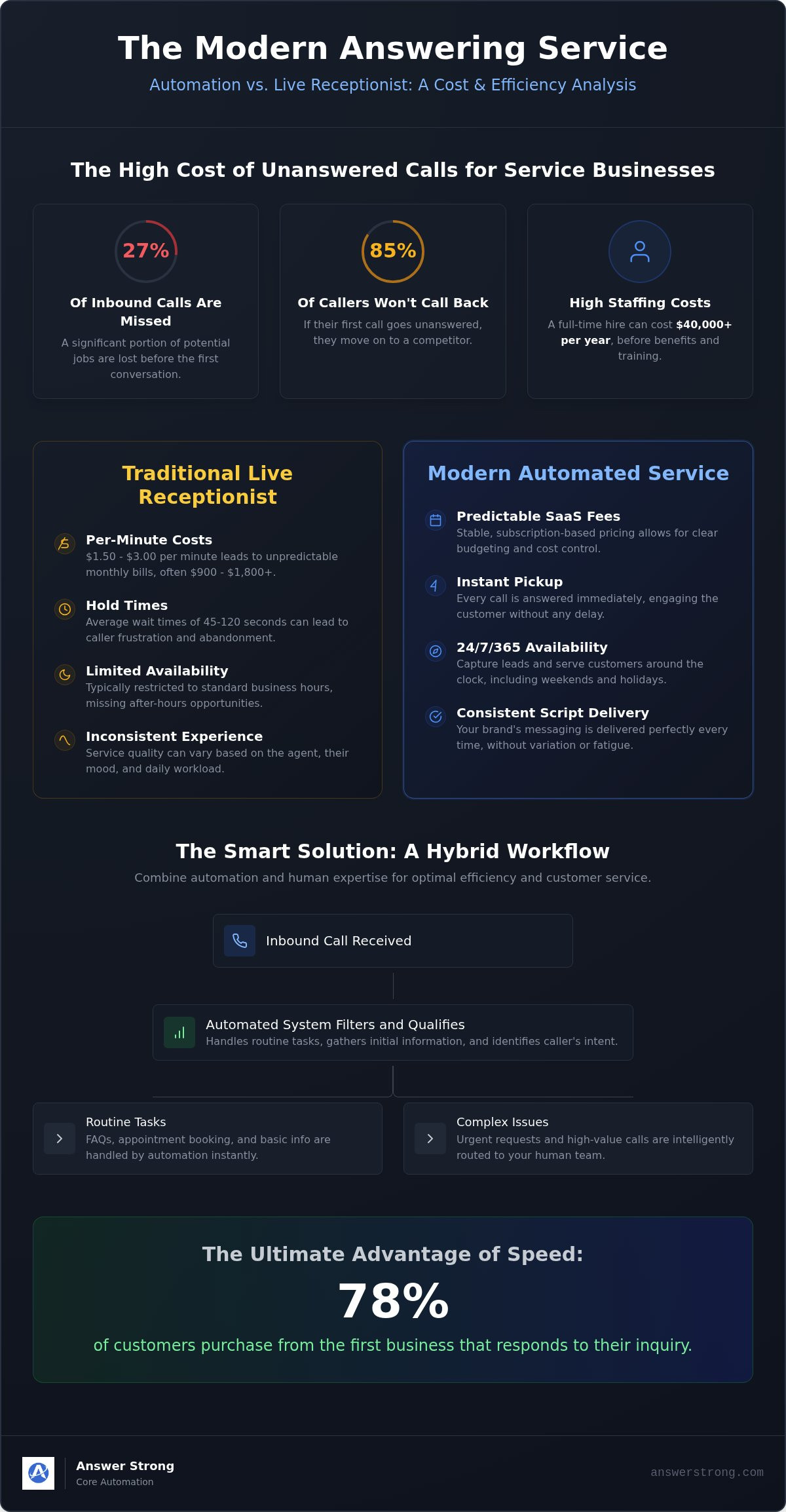
Did you know that home services businesses miss roughly 27% of their inbound calls? Even worse, research shows that 85% of those callers won't try your number a second time if they don't get a response. It's a frustrating reality for any growing company. You're often stuck on a job site or with a client, forced to choose between doing the work and answering the phone. Traditional voicemail feels like a black hole, and hiring full-time staff can cost upwards of $40,000 per year before benefits.
Choosing between a live receptionist and a modern automated answering service shouldn't feel like a gamble with your brand image. This 2026 comparison guide will show you how to build a responsive communication system that captures every opportunity without the personal burnout. We'll explore how modern technology handles routine tasks like FAQs and appointment booking while keeping your costs manageable. You'll learn to distinguish between traditional answering models and the latest automation workflows to find the right fit for your business growth.
Table of Contents
Defining the Modern Automated Answering Service
An automated answering service is a software-based system that manages inbound communication via voice and text. It functions as an Automated Attendant, greeting callers and directing them based on their specific needs. This isn't a static recording. It's a dynamic tool that uses logic-based routing to connect callers with the right department or information instantly. It ensures that a technician in the field isn't interrupted by a billing question, while an emergency lead gets prioritized. Essentially, it's a 24/7 tool designed to handle routine business workflows without human intervention.
The Shift from Voicemail to Interactive Automation
Passive voicemail is a lead killer. Industry data indicates that home services businesses miss roughly 27% of their inbound calls. When a caller hits a standard greeting and is asked to leave a message, the momentum stops. In fact, 85% of customers whose calls aren't answered won't call back. They simply move to the next name on the search results page.
Interactive automation changes that dynamic. It sets professional expectations immediately by engaging the caller. Instead of a dead-end recording, the system asks questions, gathers data, and offers solutions. This is where Core Automation excels. It handles approved, repeatable tasks like answering FAQs or capturing lead information. It turns a missed call into a structured data point in your dashboard. You get the details you need to follow up effectively, and the caller feels heard.
Why 24/7 Responsiveness is No Longer Optional
We live in an on-demand economy. Customers expect immediate answers, regardless of the time or day. Research shows that 78% of customers purchase from the first business that responds. If you're only responsive between 9 a.m. and 5 p.m., you're leaving a massive portion of the market to your competitors.
Implementing this technology ensures you capture after-hours inquiries without forcing staff to be on call. It maintains a professional presence during holidays, weekends, and peak periods. You don't have to choose between personal time and business growth. The system stays vigilant, acting as an invisible motor that keeps the business moving forward while you focus on high-value tasks. It provides a consistent experience for callers, regardless of how busy your office gets.
Automated Systems vs. Live Receptionists: A Comparative Analysis
Comparing a human receptionist to an automated answering service reveals a fundamental shift in modern business logic. Traditional live services often charge between $1.50 and $3.00 per minute. If your business handles 200 calls a month at three minutes each, you're looking at costs between $900 and $1,800 monthly. Software-based systems replace these variable, often unpredictable costs with stable SaaS fees. Speed is the second major differentiator. While traditional answering services average hold times between 45 seconds and two minutes, automation picks up instantly. It delivers your approved script exactly as intended every time. There's no fatigue, no variation in tone, and no missed details. For a deeper dive into these differences, read our Automated Answering Service vs. Virtual Receptionist: 2026 Buying Guide.
Scalability and Cost Efficiency
Marketing campaigns often create sudden call spikes that overwhelm small teams. Hiring and training a new staff member to handle a temporary surge is neither fast nor cost-effective. Automation scales the moment the phone rings. It handles increased volume without additional training or overhead. Plans like the Essential Plan provide predictable monthly budgeting, allowing you to stop paying for "dead air" or hold time. You only pay for the value created. This efficiency reduces your overall cost-per-lead by automating the qualification process before a caller ever reaches your high-paid staff.
The Hybrid Workflow: When to Use Automation vs. Humans
The best communication setup isn't a binary choice between a person and a bot. Smart businesses use a hybrid model where automation handles high-volume, routine tasks like answering FAQs and booking appointments. It acts as a professional filter. Complex issues or sensitive client interactions get routed to your team based on specific escalation rules you define. This keeps your staff focused on high-value work rather than repeating your office hours ten times a day. It supports your existing team during busy hours, ensuring no one feels overwhelmed or burnt out. You can explore our automation services to see how this balance can protect your team's time while maintaining a professional brand image.
Core Features to Evaluate in an Answering Platform
Selecting an automated answering service involves more than finding a digital greeting. You need a system that acts as a proactive filter for your business. The right platform manages the chaos of incoming inquiries by sorting them before they ever reach your desk. It uses a centralized dashboard to provide a bird's-eye view of every interaction, ensuring no lead falls through the cracks. Integrated SMS and email alerts provide real-time lead notifications, so you know exactly who called and why. Integrating professional answering services into your existing operations should be a seamless transition that strengthens your brand image.
Intelligent Call Routing and Escalation
Your routing logic acts as the brain of the operation. It directs calls to specific departments or mobile phones based on the caller's immediate needs. You can set sophisticated rules based on business hours or specific service areas. This prevents your team from wasting time on inquiries outside your geographic reach. It also protects your work-life balance by implementing after-hours routing logic. Instead of your phone ringing during dinner, the system handles the inquiry or directs it to a recorded resource. If a call meets specific criteria for an emergency, it escalates to a human staff member immediately. This ensures sensitive situations get the attention they deserve while routine questions stay automated.
SMS Follow-Up and Appointment Syncing
Speed is everything in 2026. If a line is busy, an automated text-back feature is critical for retaining that caller. Most people won't wait on hold; they will, however, respond to a text. This feature initiates a conversation instantly, keeping the lead warm while you're occupied. High-performing platforms sync directly with digital calendars to allow callers to book appointments in real-time. The system collects lead details like names, locations, and service needs automatically. It populates your centralized dashboard at portal.answerstrong.com with actionable data. This turns a simple phone call into a scheduled job. This level of responsiveness builds trust before you even speak to the customer, making your business appear larger and more organized than the competition.
Operational Workflows for Service-Based Industries
Every industry faces unique communication hurdles. An automated answering service provides the flexibility to build logic that mirrors your specific business rules. For instance, growing service enterprises often struggle with multi-location routing. A centralized system identifies a caller's needs and directs them to the nearest branch or technician. This ensures your brand image remains consistent across different regions without requiring local receptionists at every site. Whether you are managing a fleet of trucks or a single storefront, the goal is to keep the "invisible motor" running in the background.
Salons and barbershops face a different challenge: the active client session. A stylist cannot stop a haircut to answer a booking inquiry. Automation steps in to handle these appointments, syncing with digital calendars so the pro stays focused on the chair. For trade professionals, the stakes are even higher. You can learn more about this in our Automated HVAC Booking: A Complete 2026 Guide. Transitioning to these workflows allows you to optimize your lead capture immediately.
High-Volume Lead Capture for Contractors
Contractors often deal with "tire-kicker" calls that waste valuable administrative time. Modern automation filters these by asking for the service area and job type before a human ever picks up. If a caller is outside your territory, the system provides helpful information instead of taking up a technician's time. This logic prioritizes urgent repair calls over general inquiries. It ensures that a homeowner with a flooded basement gets a faster response than someone asking about a quote for next month. You spend less time on low-value coordination and more time on billable work.
After-Hours Handling and Message Taking
Responsiveness shouldn't require you to be on call at all hours. When the office is closed, your system provides callers with approved pricing and service information. This keeps the lead engaged and prevents them from calling a competitor. Transcription features allow you to review call summaries at the start of the next business day via your centralized dashboard at portal.answerstrong.com. You get a clear, written record of what the caller needed, making follow-ups efficient and professional. It maintains a high level of availability without the personal burnout associated with traditional on-call rotations.
Optimizing Communication with Answer Strong Core Automation
Implementing an automated answering service shouldn't mean losing your brand's personality. It means amplifying your reach. Core Automation serves as the engine for your business communication. It handles the heavy lifting of lead capture and scheduling. This system isn't just a tool. It's a vigilant digital coworker that works while you're off the clock. You can start with a single line and expand to multi-location logic as your enterprise grows.
The Essential Plan provides a centralized platform for calls, texts, and bookings. You have total flexibility with your phone setup. You can choose a new local or toll-free number. Or, you can integrate your existing business line to maintain continuity. This ensures your customers reach the same familiar number while you benefit from modern automation. It's about building a system that scales with your ambition.
Customizing Your Automated Receptionist
Your system should sound like your business. You can set up professional greetings that reflect your unique brand voice. Don't settle for generic recordings. Configure specific FAQ responses based on your current services and policies. If a customer asks about your service area or pricing, the system provides the answer you've approved. You can monitor every interaction through the Answer Strong dashboard at portal.answerstrong.com. This transparency allows you to fine-tune your workflows based on real caller data. You'll see exactly how many leads are captured and how many appointments are booked in real time.
Getting Started with a Professional System
Launching a professional system is straightforward. You'll choose between the Starter and Essential plans based on your monthly call volume. The Starter plan works well for those just beginning to automate routine inquiries. The Essential plan offers a more robust suite of features for businesses ready to scale their lead capture and communication workflows. You can also scale your system by adding Conversational Core Minutes as your business grows. The process of porting or forwarding an existing number is handled with precision. You won't face long downtimes or technical headaches. Once active, your automated answering service runs with the stability of an invisible motor. Explore our available plans today to find the right fit for your business growth and take the stress out of every inbound call.
Scalable Growth Starts with Smarter Communication
The choice between traditional staffing and a modern automated answering service comes down to one thing: growth without the friction. You've seen how passive voicemail leads to lost leads and how high human overhead can drain your resources. Core Automation acts as the invisible motor for your business, handling routine, repeatable tasks like lead capture and scheduling while you focus on high-value work. It ensures that every caller is greeted with professionalism, regardless of the time or day.
By utilizing an all-in-one platform for calls, texts, and appointments, you gain full visibility through a centralized dashboard. You no longer have to choose between personal time and professional responsiveness. Whether you're a contractor in the field or a salon owner behind the chair, your communication system should work as hard as you do. It's time to trade the stress of missed calls for a system that remains vigilant and reliable.
Ready to streamline your operations? Find the Right Answer Strong Setup for Your Business and start building a system that scales with your ambition. Your business is ready for the next level, and the right tools will help you reach it with confidence.
Frequently Asked Questions
What is an automated answering service?
An automated answering service is a business communication platform that combines professional phone services with Core Automation. It manages calls, inquiries, and routine workflows without requiring constant manual monitoring. Unlike a basic recording, this system interacts with callers to provide FAQs, capture leads, or route conversations based on logic you define. It acts as an invisible motor, keeping your business responsive 24/7.
Can Answer Strong replace a live receptionist?
It can function as your primary support or work alongside your existing staff. While Answer Strong doesn't provide live human agents, the automation handles routine tasks like FAQ responses and lead qualification. This provides essential coverage during after-hours, sick days, or busy periods when your team is occupied. It ensures no high-value lead is ignored while your staff focuses on complex, judgment-requiring interactions.
How does Core Automation handle appointment scheduling?
Core Automation manages appointment requests based on the specific scheduling rules and integrations you configure. The system gathers necessary details from the caller and syncs with your digital calendar to finalize the booking. This process eliminates the back-and-forth of manual scheduling. Callers get immediate service, and you see new appointments appear directly in your centralized dashboard at portal.answerstrong.com.
Can I keep my existing business phone number?
You can definitely keep your current number through call forwarding or supported number-transfer processes. This allows you to maintain your established brand identity while upgrading your backend technology. If you prefer a fresh start, Answer Strong also provides new local or toll-free numbers. Either way, the integration is designed to be seamless, ensuring your customers never experience a gap in service.
Does an automated service sound robotic to my customers?
Modern systems use professional greetings and knowledge-base supported replies to maintain a high standard of communication. The interaction is designed to be helpful and direct, focusing on solving the customer's problem quickly. By providing approved pricing and service details immediately, the service often feels more efficient than waiting on hold for a traditional operator who might lack specific business knowledge.
Is Answer Strong suitable for multi-location businesses?
Advanced configurations within the platform support multi-location routing and sophisticated workflow logic. This is ideal for growing enterprises that need to direct callers to specific branches or technicians based on their geographic location. You can manage all locations through a single centralized dashboard. This maintains a unified brand image while ensuring that leads are handled by the correct regional team.
Can the system capture lead information automatically?
The system is designed to collect approved customer details like names, contact information, and specific service needs. It qualifies leads by asking about their location or the urgency of their request before the data is logged. You can review these structured summaries instantly via the dashboard or receive real-time SMS alerts. This automation ensures you have all the facts before you even return the call.
Do I need to buy special hardware or a new phone?
You don't need to purchase any physical VoIP hardware or new phones to use this service. Calls are routed to your existing mobile devices, office phones, or specific employee lines. The entire system is managed through a web-based dashboard. This setup allows you to stay connected and responsive from a job site or a home office without the clutter of extra equipment.



Comments