

Automated Answering Service vs. Virtual Receptionist: 2026 Buying Guide
- 15 hours ago
- 12 min read
An estimated $3 trillion in global sales is currently at risk due to poor customer experiences, according to research from AmplifAI. For a growing business, a single missed call isn't just a notification. It's a lost opportunity. When you're deciding between an automated answering service vs virtual receptionist, you're looking for a way to stay responsive without the overhead of a traditional call center. You need an alert, always active digital coworker to handle the front line.
You know the frustration of losing high-intent leads while you're busy on a job site. You want to sound professional. However, the high monthly costs of live staff don't always align with your budget. It's a common challenge for leaders who want to scale without losing the personal touch. At Answer Strong, we provide the tools to ensure your business remains unshakeably reliable. We remove the stress of growth.
This 2026 buying guide compares the costs, capabilities, and customer experience of live receptionists against modern automation. You'll learn how to maintain a professional image and capture leads 24/7 without hiring full-time staff. We'll break down the data to help you build a more responsive business that stays active even when you're off the clock.
Table of Contents
The High Cost of Silence: Why Your Answering Strategy Matters
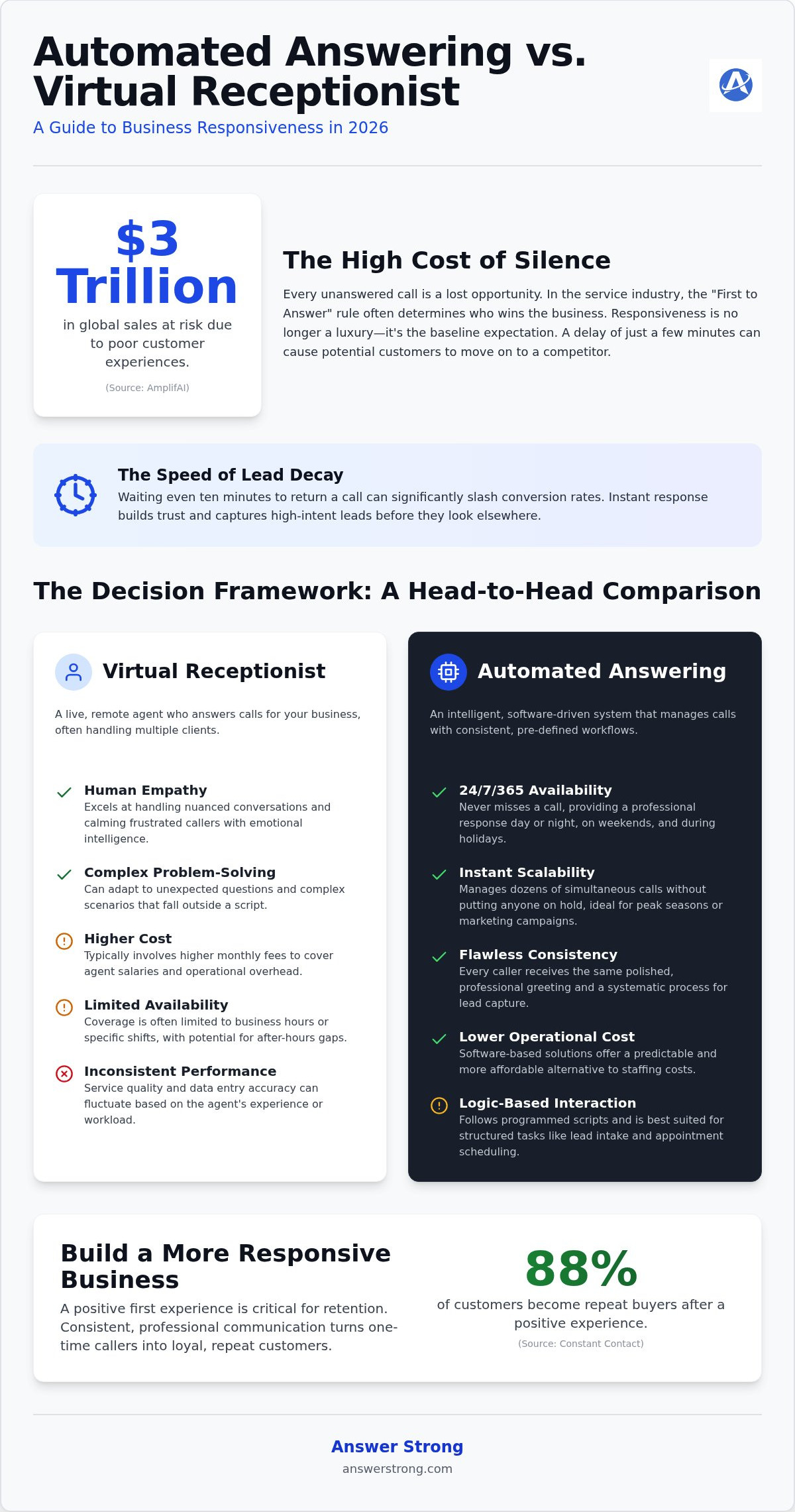
Silence is the most expensive sound in business. Every time your phone rings and goes unanswered, your revenue potential takes a hit. Research from AmplifAI suggests that $3 trillion in global sales is at risk because of poor customer experiences. For service-based businesses, the stakes are even higher. A missed call isn't just a minor delay; it's an invitation for your prospect to call the next name on the list.
Choosing between an automated answering service vs virtual receptionist is a critical decision for your 2026 growth strategy. Both aim to solve the same problem: lead decay. When a high-intent lead calls an HVAC or plumbing company, they expect a solution, not a recording. Traditional voicemail has become a lead killer. It signals that you're too busy to care, pushing the caller straight into the arms of a more responsive competitor.
The True Impact of Unanswered Inquiries
In the service industry, the "First to Answer" rule often determines who wins the contract. If you're on a job site, you can't always pick up. However, waiting even ten minutes to return a call can slash your conversion rates. Responsiveness builds brand authority before you even step foot on a property. It shows you're organized, reliable, and ready to work. Consistent communication turns a one-time caller into a repeat buyer. Constant Contact reports that 88% of customers are likely to become repeat buyers after a positive experience. Missing that first touchpoint means you're not just losing one job; you're losing the lifetime value of that customer.
Modern Consumer Expectations in 2026
Consumer behavior has shifted toward instant gratification. By 2026, 24/7 availability isn't a luxury; it's a baseline requirement. Callers no longer accept "leave a message" as a valid response. They want to know their problem is being handled right now. Many businesses start with a basic Automated attendant to route calls, but modern expectations demand more than just a menu. People want two-way interaction and quick resolutions. Whether it's through a voice call or an immediate follow-up, staying connected is the only way to maintain customer satisfaction. Balancing this need for responsiveness with actual revenue-generating work is the ultimate challenge. You can't grow if you're stuck on the phone, but you won't have work if you don't answer.
Live Receptionists vs. Automated Systems: Defining the Landscape
Choosing the right front end for your business requires a clear understanding of the fundamental differences in how inquiries are processed. When evaluating an automated answering service vs virtual receptionist, you aren't just picking a tool; you're selecting an operational philosophy. One model relies on human bandwidth and intuition. The other leverages programmed logic and software driven workflows to ensure every interaction follows a precise path. Understanding these distinctions is the first step toward building a system that scales with your ambition.
Understanding Live Answering Services
A virtual receptionist is a live human agent who answers calls from a remote facility. These professionals often operate in a shared environment, switching between various clients throughout the day. The primary benefit of this approach is empathy. Humans excel at handling nuanced situations or calming frustrated callers through emotional intelligence. Yet, this human element introduces variables. Performance can fluctuate based on the agent's experience level or current call volume. Training a remote team to represent your brand accurately requires ongoing effort. As noted in Forbes' analysis of leading answering services, the trade off for human interaction often includes higher costs and the risk of inconsistent data entry during busy shifts.
The Rise of Core Automation
Modern technology has moved past the era of simple auto attendants. We now see the rise of intelligent workflow engines. These systems provide a level of consistency that human teams struggle to maintain. Every caller gets the exact same professional greeting and follows a vetted sequence for lead capture or appointment scheduling. Core Automation doesn't get tired or distracted. It handles routine FAQs and administrative tasks with surgical precision. Because it's software based, it scales instantly. It can manage multiple simultaneous calls during a morning rush without making a single person wait on hold. This ensures that your business stays active and professional at all times.
The true power of modern automation lies in its ability to sync with your business ecosystem. It doesn't just take messages; it executes actions. Whether it's updating your calendar or pushing lead data to a centralized dashboard, the process is seamless. This creates an invisible engine that drives your business forward while you're on a job site or in a meeting. If you're ready to move beyond manual message taking, you can learn how Answer Strong uses Core Automation to bridge the gap between basic routing and full scale task execution. This setup ensures your business remains responsive 24/7 without the overhead of full time staff.
The Decision Framework: Cost, Speed, and Scalability
Choosing between an automated answering service vs virtual receptionist requires looking at the raw numbers. It isn't just about the monthly bill. You have to consider the Total Cost of Ownership (TCO). A system that handles calls efficiently reduces your administrative burden; it doesn't just pass the buck. You need a setup that provides precision and reliability without the unpredictable costs of human bandwidth. Scaling your business requires a framework that favors speed and data accuracy.
Cost Analysis: Subscription vs. Hourly
Live answering services usually charge by the minute. This creates a financial risk. Every wrong number, telemarketer, or long winded caller increases your overhead. You also face hidden costs like setup fees and the time required to train remote staff on your specific service area. These variable expenses make budgeting difficult for growing teams. Answer Strong offers predictable plans that eliminate these surprises. You can learn more about Core Automation at Answer Strong to see how routine tasks are handled at a fixed rate. This shift from variable to fixed costs allows you to reinvest your savings back into your core operations.
Speed of Response and Availability
In a competitive market, speed is your greatest advantage. Live receptionist queues can lead to hang ups if the wait time exceeds thirty seconds. Automated systems provide an instant pickup. Core Automation provides 24/7 availability for routine tasks like lead capture, appointment scheduling, and answering FAQs. This "always on" nature ensures that a midnight inquiry gets the same level of attention as a midday call. You stay responsive while you sleep; you ensure no high intent lead goes uncaptured.
Reliability is another critical factor. Software doesn't take sick days or coffee breaks. Your business isn't static. A slow Tuesday might bring five calls, while a sudden weather event could bring fifty inquiries in a single morning. A live receptionist team has a fixed capacity. If their queue is full, your callers wait. Automation scales instantly. It handles surges without a drop in quality or tone. Digital systems also provide cleaner lead notes. They follow a strict, repeatable workflow for every interaction. This leads to better data management and fewer errors when it's time to follow up on a lead. When you combine this accuracy with 24/7 availability, the financial benefit of automation becomes clear.
Industry-Specific Needs: Finding Your Perfect Fit
Different industries face unique communication bottlenecks. Your choice between an automated answering service vs virtual receptionist should depend on your specific daily workflow. For home service providers like HVAC technicians or plumbers, every second matters. If a homeowner has a burst pipe at 2 a.m., they won't wait for a callback. They'll call the next company on the list. Automation ensures that lead capture happens instantly; you stay in the game even if you're currently on another job site.
The Service Provider Workflow
Emergency routing requires a different logic than routine maintenance requests. Smart systems can identify urgent needs and alert you immediately, while routine inquiries follow a standard booking path. You shouldn't spend your billable hours answering the same questions about service areas or pricing FAQs. Protecting your time allows you to focus on the technical work that drives your revenue. To see how this works in practice, explore our Automated HVAC Booking: A Complete 2026 Guide.
Salons and barbershops deal with a high volume of scheduling requests. A live virtual receptionist often struggles to manage real-time availability across multiple staff members or locations without making mistakes. Modern automated systems sync directly with your calendar to provide a seamless booking experience for the client. This level of precision builds trust and keeps your schedule organized.
Appointment-Based Business Solutions
No-shows are a major profit killer for mobile and retail businesses. Automated SMS and email reminders ensure your clients stay informed and arrive on time. This synchronization happens in the background, so you don't have to send manual follow-ups. You can learn more about these tools in our Automated Scheduling: 2026 Mobile Business Guide. These systems handle the administrative burden so you can focus on your craft.
Professional services and sales teams use automation to qualify leads before a human ever speaks. According to AmplifAI, 73% of consumers will switch to a competitor after multiple negative interactions. By using an automated system to vet inquiries, you ensure your staff only spends time on high-value conversations. This maintains a professional image while drastically improving operational efficiency. If you're ready to upgrade your response strategy, view our available service plans to find the right fit for your team.
Building a Responsive System with AnswerStrong
Scaling a business requires a system that operates without your constant supervision. When comparing an automated answering service vs virtual receptionist, the goal isn't just to pick a service; it's to build a foundation for growth. The AnswerStrong Essential Plan provides professional communication for teams that need to stay responsive while focusing on high-value work. This setup leverages Core Automation to bridge the gap between basic routing and the personal touch of a live agent.
A hybrid approach often works best for modern service providers. While automation handles routine lead capture and FAQs, escalation rules allow complex inquiries to reach a human team member when necessary. This ensures that your business remains accessible 24/7 without the high costs associated with traditional call centers. You get the stability of a digital system and the flexibility to step in when it matters most. It's about being present for your customers without being tethered to your phone.
How AnswerStrong Works for You
Success starts with customization. You can tailor your professional greetings and FAQ responses to match your brand voice. This ensures every caller receives a consistent experience. By integrating your existing calendar, the system manages real-time appointment requests without manual entry. You don't have to worry about double bookings or missed follow-ups. Everything is tracked through a centralized dashboard. You can monitor activity and review lead notes at any time. This visibility gives you total control over your business communication while you're on a job site or in a meeting.
Next Steps for Your Business Communication
Improving your responsiveness starts with an honest evaluation of your current call volume. Think about the missed opportunity costs of every call that went to voicemail last month. Capturing those leads is the fastest way to increase your revenue. You can choose to set up a new local business number or integrate your existing one to keep your branding consistent. Setting up intelligent routing ensures that every inquiry follows a vetted path to resolution. If you're ready to build a more efficient operation, you can explore AnswerStrong plans to find the right fit for your business goals. Transitioning to a smarter system allows you to stay active, professional, and ready for every new lead that comes your way.
Master Your Response Strategy for 2026
Your business growth depends on how you handle the next ring. We've explored the critical trade-offs of an automated answering service vs virtual receptionist, from lead decay to operational scalability. While live staff offers empathy, digital systems provide the unwavering consistency and speed that modern consumers demand. You don't have to choose between quality and efficiency when you have a system built for precision.
AnswerStrong helps you stay responsive without constant phone monitoring. Our 24/7 Core Automation handles routine tasks like lead capture and FAQs; meanwhile, integrated appointment scheduling keeps your calendar full. You can track every interaction through a centralized dashboard, ensuring you stay in control of your professional image. It's time to stop losing leads to silence and start building a more resilient operation.
Take the next step in your professional communication. Explore AnswerStrong and Build a Stronger Communication System today. You're ready to scale, and your business deserves a system that works as hard as you do.
Frequently Asked Questions
What is the main difference between an automated answering service and a live receptionist?
The primary difference between an automated answering service vs virtual receptionist is the method of delivery. Virtual receptionists are human agents who answer calls remotely, while an automated service uses a software-driven workflow engine. Automation ensures every caller receives an identical professional experience without the variability of human fatigue. This model allows for instant scaling during busy periods, whereas a live service depends on agent availability and human bandwidth to manage your inquiries.
Is an automated answering service professional enough for my small business?
Modern automation is designed to enhance your professional image by providing clear, consistent communication. Unlike traditional voicemail, an automated system follows your specific business rules to capture leads and answer FAQs accurately. It eliminates common issues like background noise or inconsistent message taking that can occur with remote human staff. This reliability builds trust with your callers, ensuring they feel their inquiry is being handled by a competent, organized business that values their time.
Can automated systems actually schedule appointments on my calendar?
Yes, intelligent automated systems can manage real-time appointment scheduling by integrating directly with your business calendar. You set the rules for your availability, and the platform handles the rest. This eliminates the back-and-forth of manual booking. Once a request is made, the system can send instant SMS or email confirmations to the customer. This ensures your schedule stays full and organized while you focus on delivering your services on-site or in meetings.
How much does a typical phone answering service cost in 2026?
In 2026, costs for answering services typically follow a subscription-based model with tiered plans. Many providers offer a base monthly fee that includes a set number of minutes or features, with additional costs for higher usage. When comparing an automated answering service vs virtual receptionist, automation is often more predictable because it lacks the high per-minute overage charges common with live staff. You should evaluate your call volume to find a plan that supports your growth.
Can I use my existing business phone number with an automated service?
You can keep your existing business phone number by using call forwarding or supported number-transfer processes. This allows you to integrate automation into your current workflow without needing to update your marketing materials or business cards. If you prefer a fresh start, you can also obtain a new local or toll-free number through the service. This flexibility ensures that you maintain your brand identity while upgrading the technology that powers your customer communication and lead capture.
Does AnswerStrong replace my current receptionist or work alongside them?
AnswerStrong is designed to be flexible; it can act as your primary communication system or work alongside your existing staff. Many businesses use it to handle overflow calls when their internal team is busy or to provide 24/7 coverage after hours. It's also an effective tool for managing communications during vacations or sick days. This ensures your business stays responsive at all times without requiring you to hire additional full-time personnel to manage call surges.
How does Core Automation handle complex customer questions?
Core Automation is built to manage approved, routine, and repeatable communication tasks such as lead qualification and scheduling. For complex or sensitive questions that require human judgment, the system uses escalation rules to route the call to a live person. This hybrid approach ensures that routine inquiries are handled with surgical precision while your team remains available for high-value interactions. It creates a seamless experience where technology supports your human expertise instead of trying to replace it.
Will an automated system help me capture more leads after hours?
An automated system ensures your business remains active 24/7, allowing you to capture high-intent leads even after you've closed for the day. Instead of callers reaching a dead-end voicemail, they interact with a system that can collect their details and schedule follow-ups immediately. This responsiveness is critical because most customers will move to a competitor if they don't get an instant answer. Automation bridges the gap between your working hours and your customers' needs.


Comments